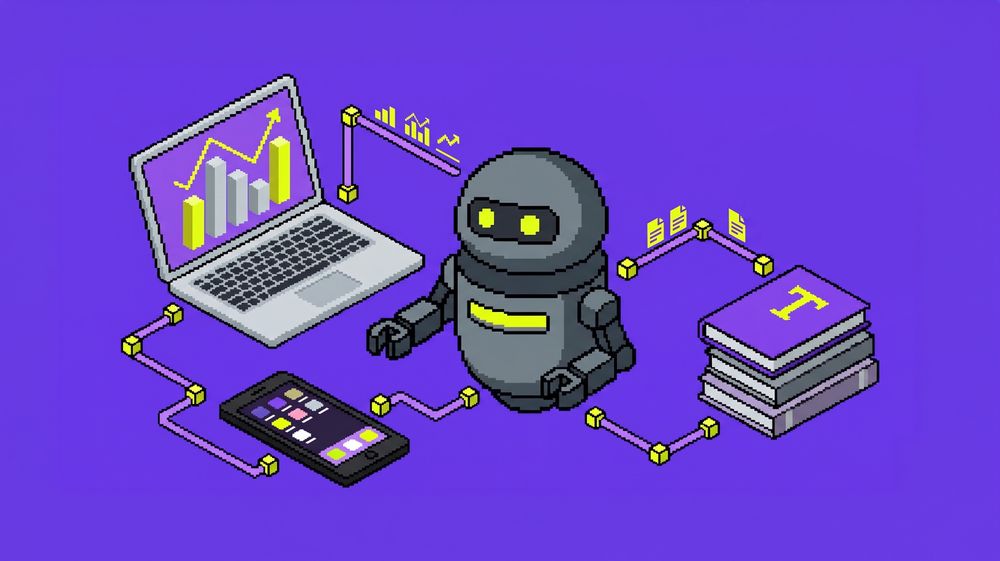
But while many companies are still discussing how to optimize button colors, the next stage of digital evolution has already begun: the Agentic Web. Those who do not prepare their website for autonomous AI systems now will lose direct contact with customers—and leave the field to the competition.
Your new top users: AI agents
A KI agent is not a conventional chatbot that merely answers questions. It is a digital assistant system (based on models like ChatGPT or Claude) that acts on behalf of the user. It not only searches for a free slot in the calendar but schedules the appointment directly. It not only compares rates but also concludes them. The problem: Until now, these agents had to laboriously interpret the visual layout of a website, like a human. This is error-prone and slow.
This is where the technology comes into play that will fundamentally change your conversion architecture.
WebMCP: The fast lane for Your conversions
WebMCP stands for Web Model Context Protocol. It is a new, open web standard that tech giants like Google and Microsoft are currently working on (currently being introduced at the W3C Web Machine Learning Community Group). This new standard allows websites to provide their features directly for AI models such as ChatGPT, Claude, or Gemini.
Until now, AI agents had to painstakingly interpret the visual layout of a website, just like a human, to execute actions. This process is error-prone, slow, and costly. WebMCP reverses this principle: Communication between the website and AI runs through a structured interface directly with the AI, telling it, "Here are the tools (called 'Tools' in this context) you can use." Instead of elaborate prompts guiding an LLM through unstructured page content, agents receive directly machine-readable functions via WebMCP tools.
The WebMCP specification was jointly developed by engineers at Google and Microsoft and is being advanced as an open standard through the W3C Web Machine Learning Community Group.
W3 Web Street Journal
Receive our W3 quarterly report with insights and highlights from digital projects, the agency, and views beyond the digital storytelling horizon. Free and directly to your email inbox.
From Element to Tool
Instead of hiding functions deep in the backend, WebMCP makes existing website elements usable for AI. Whether simple forms or highly complex JavaScript logics – WebMCP acts as a translator:
Structured definition: Each interaction is stored with a clear name, a precise description, and a defined data schema. So the AI not only knows that it can do something but also exactly what information (e.g., a postal code or a specific date) it needs to provide.
Seamless execution: The AI triggers actions directly in the existing website logic. Whether a real-time availability query or the transmission of a complex data set – the agent uses the already existing infrastructure of your site. Changes to the UI design do not affect the stability of the agent workflows. The role of WebMCP is to ensure this decoupling.
WebMCP: a Practical example
A user tells their AI assistant: "Book a consultation with W3 Digital Brands for next week Tuesday."
Without WebMCP: The agent loads the page, looks for the "Contact" menu item, interprets the form, and in case of doubt, fails at a pop-up.
With WebMCP: The agent immediately sees the provided tool "book_consultation". He transmits the parameters in the background, the user clicks once on "Confirm" – done. No searching, no scrolling, no frustration.
Control always remains with the human: Every action requires explicit user approval (Human-in-the-Loop), similar to querying location data on a smartphone. Technically speaking, WebMCP is not an autonomous remote control mode, but an assisted process. Security is firmly embedded in the protocol: Every action that an agent wants to perform via WebMCP requires a explicit user approval. Comparable to requesting location data or camera access, the user decides by clicking whether the agent is allowed to use the tool. The website provides the possibilities, the agent the execution, and the human retains full sovereignty.
Why WebMCP is a Game-Changer for C-Level and Marketing is
Whoever optimizes their website today as a "first mover" for WebMCP secures tangible competitive advantages and a Technological advantage in terms of next-generation visibility.
1. Zero friction and drastically higher conversion rates
Studies show that structured interactions via WebMCP increase the success rate in complex tasks by increase by up to 98% and the computational effort for approx. 67% reduce can. Because classic digital interaction often fails at the "Last Mile" – complicated menu navigation, endless form fields, and confusing checkout processes lead to increased dropout rates. WebMCP radically eliminates these friction losses. Instead of users having to manually operate your page, they delegate the task to their AI agent, which communicates directly with your website logic through WebMCP. Whether it's complex product configurations or appointment bookings: The hurdle of manual input disappears.
2. Scalable efficiency without backend chaos
Instead of building separate, expensive APIs for each new AI platform (OpenAI, Anthropic, Google), WebMCP uses the existing logic of your website as a universal standard. The save massive development costs – and keeps your IT architecture lean. Existing JavaScript logic can be easily exposed without needing to rebuild the backend. Similarly, separate backend integrations are eliminated. This is because WebMCP allows frontend logics to be provided directly as tools for AI agents. In short: Less effort, more performance.
3. Accessibility 2.0
WebMCP makes your brand radically accessible and acts as the ultimate assistant system. People with physical or cognitive limitations can easily delegate desired actions to their AI agent, which then flawlessly performs the corresponding interactions for them.
4. Future-Proof Brand Perception
Your customers expect seamless experiences. If the agent can book with the competition because your website locks them out, you lose revenue. And your reputation. WebMCP ensures your brand's pole position into the future.
Conclusion: Will you "Agent-ready"
Our W3 expert assessment: In less than two years, it will be standard for AI systems to be the primary interface between your company and your customers. WebMCP is your ticket to this era. It is not about replacing human contact but making the path to your offerings and brand as profitable and easy as possible.
The advantages at a glance:
Future-proofing: Preparing for the era of AI assistants and the agentic web.
Performance: Faster, more stable interactions without the potential for errors – thanks to structured tools instead of visual interpretation.
Efficiency: No separate backend integrations – existing JavaScript logic is used directly.
Brand strength: A seamless user (and agent) experience directly influences brand perception.
Is your digital strategy ready for the era of agents? Let's jointly explore in a non-binding exchange how we can optimize your website not only for people but also for the intelligent systems of the future. And turn it into a true high performer on the Agentic Web.